
What table turns change on the floor
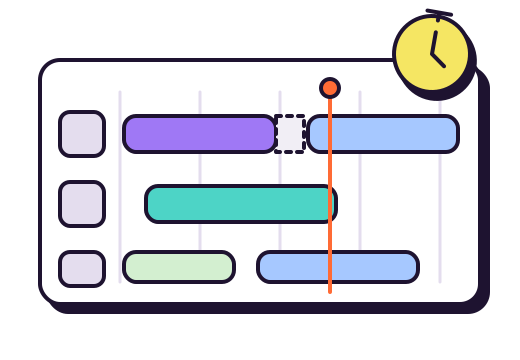
Without turns, each table takes one booking per service. A table for 4 booked at 7:30 pm is blocked all evening, even if the guests leave at 9 pm. With turns, the same table can take a second booking at 9:15 pm.
On a full night, the difference is counted in covers. A 12-table restaurant that turns half of its tables once gains six bookings, without one more chair. Research on capacity management in restaurants has long shown it: meal duration and the spacing of arrivals weigh as much as the number of seats.
Measure before you set
The right durations are yours, not those of a table in an article. For two weeks, note for each table the arrival time and the time it is ready again, cleared and reset. Separate lunch and dinner, weekdays and weekends, and group by table size.
You will get average durations, but look above all at the long ones: if one table for 4 in five goes beyond 1 h 45, setting 1 h 30 will create overlaps almost every night. Better a duration that covers most meals than an average that half of them overrun.
Durations by table size
A table for 2 does not eat at the same pace as a party of 8: the more people, the longer ordering, serving and paying take. So set one duration per table size, and per service. For large parties, see also how to host a big table.
| Table size | Weekday lunch | Dinner | Saturday dinner |
|---|---|---|---|
| 1 to 2 covers | 1 h 15 | 1 h 45 | 2 h |
| 3 to 4 covers | 1 h 30 | 2 h | 2 h 15 |
| 5 to 6 covers | 1 h 45 | 2 h 15 | 2 h 30 |
| 7 covers and more | 2 h | 2 h 30 | 2 h 45 |
These values are a starting point for a bistro serving a starter, a main and a dessert; a fast brasserie will be shorter, a fine-dining table much longer. Replace them with your own measurements. At weekday lunch, when many guests only have an hour, durations get shorter still: that is the subject of our guide to filling your restaurant at lunchtime.
Clearing is part of the duration
A booking’s duration runs from the guests’ arrival until the table is ready for the next ones. Clearing, cleaning and resetting a table takes time, especially on a busy night. Count it inside the duration rather than adding it separately: it is simpler to set and closer to reality.
Running two sittings
The classic case: a first sitting around 7 pm, a second around 9:15 pm. For it to work, three settings matter. Sunday brunch works the same way, with its own durations: see how to run a Sunday brunch service.
- Arrival times: offer slots that leave room for the table’s duration. A table for 4 booked at 7 pm with a 2-hour duration cannot be offered again before 9 pm.
- Spacing arrivals: ten tables arriving at 7:30 pm sharp means an overwhelmed kitchen and longer meals for everyone. Limit the number of covers per slot: pacing booking slots to the kitchen explains how.
- A buffer for the second sitting: keep a few tables without turns, to absorb a dessert that drags on without making the next guests wait. A floor plan with two-tops that join up gives the same flexibility.
When not to turn tables
Table turns are not compulsory. On some nights, they do more harm than good: New Year’s Eve, Valentine’s Day, a tasting menu, a themed evening. Guests come to take their time; announcing a departure time spoils the moment.
On those nights, switch turns off for the service concerned: each table takes only one booking. That is exactly what gonnabook.it allows: durations by table size and by service, clearing included, and turns you can switch off for the whole restaurant, for one service or for a single evening.
Talking about time with guests
If you run two sittings, say so at booking: “Your table is booked from 7 pm to 9 pm.” Announced in advance, it goes down well; discovered at dessert, it does not. And if a first-sitting guest lingers, offer to let them finish at the bar rather than rushing them.
Frequently asked questions
What is a restaurant’s table turnover rate?
It is the average number of times a table is used during a service. A rate of 1.5 at dinner means that, on average, one table in two takes two bookings.
How long does a restaurant meal last?
It depends on the type of restaurant, the service and the table size. The most reliable way is to measure your own meals for two weeks, lunch and dinner separately.
Should guests be told they have the table for a limited time?
Yes, at booking, if you run two sittings. An end time announced in advance is well accepted; a surprise at dessert much less so.
Sources
- Sheryl E. Kimes et al., “Restaurant Revenue Management: Applying Yield Management to the Restaurant Industry”, Cornell Hotel and Restaurant Administration Quarterly, vol. 39, no. 3, 1998.
- Sheryl E. Kimes and Gary M. Thompson, “Restaurant Revenue Management at Chevys: Determining the Best Table Mix”, Decision Sciences, vol. 35, no. 3, 2004.
- The durations in the table and the 12-table example are illustrations, not statistics.