
When does a booking become a group?
There is no universal number: a group is the party size at which a table changes the way you work. In a 40-cover bistro, for instance, it might be 8. In a 150-seat brasserie, more like 15. Three questions help you set yours:
- The table: above what size do you need to push tables together or move furniture?
- The kitchen: above what size does an à la carte order slow down the rest of the room?
- The risk: above what size would a no-show really cost you the evening?
Below that line, let the booking go through online like any other. Above it, switch to a request: the guest gives the date, time and party size, and you reply. It is not mistrust. It is the moment you check the space, suggest a menu and set the rules.
That is the setting gonnabook.it offers: above the “Largest online party”, the booking arrives “To confirm” and the restaurant accepts or declines it.
Plan the table and the floor
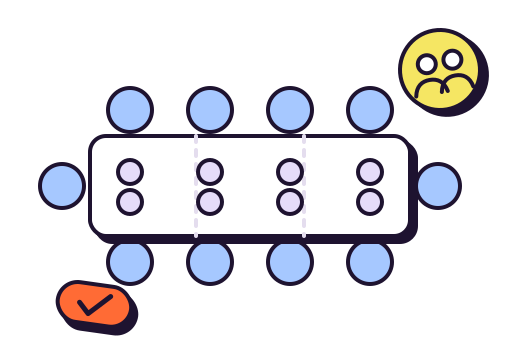
A large table is usually built from twos or fours pushed together. Before you accept, check three things:
- The combination works: which tables go end to end, and how many seats that really gives (corners often lose a few; see a floor plan with tables that join up).
- People can still move: the path to the kitchen, the restrooms and the exit must stay clear.
- The rest of the room holds up: taking four two-tops for the group means four fewer bookings that night.
Seat the group where it disturbs least: a separate room, the back of the dining room, or an area you can close off. Groups are loud; better to plan for it than to apologise to the next table.
Stagger the firing and allow more time
A group never sits down all at once. Plan for it: give an arrival time, and move the neighbouring bookings by fifteen minutes so the kitchen is not firing the group alongside three other tables.
In the kitchen, fire in waves: the group’s starters first, then the rest of the room, then the group’s mains. A plate waiting five minutes on the pass beats ten tables served late.
Finally, a large party stays longer than a two-top. If you run two seatings, do not resell its table for the second turn: hold it for the evening, or allow a much longer duration (see our article on table turns).
Confirm the headcount at seven days, then two
A group booked for 12 that shows up as 8 means four empty covers, and often four guests you turned away. Two check-ins are enough:
- Seven days out: the organiser confirms the date, time, menu and an approximate number.
- Two days out: they confirm the final number. That is the figure the kitchen works from, and the one you bill on if your policy says so.
Put it in writing when you reply to the request: “Please confirm your final numbers no later than two days before.” For parties that do not show at all, the tactics in our article on no-shows apply to groups too.
Deposits, if you need them
For a large party, asking for money up front is common. Be careful with the words, because the rules depend on where you trade. In France, for example, Article L214-1 of the Consumer Code says that, unless the contract states otherwise, sums paid in advance are arrhes: the guest can walk away by losing them, and a restaurant that cancels must pay back twice the amount. A firm deposit (acompte) binds both sides. Other countries have their own rules on deposits and cancellation charges: check yours with a local adviser.
Wherever you are, the practical rule is the same: state in writing what the payment is, how much it is and the cancellation deadline before the guest pays. It is also the rule for the big festive nights: see Christmas and New Year’s Eve menus, timings and deposits.
Private hire, in a few lines
Past a certain size, the group no longer wants a table but the room. Treat private hire (a buyout, as it is often called in the US) like a quote: a minimum spend or a price per head, a fixed menu, an end time, and the other bookings for that slot closed. Get it agreed in writing, and tell your team early. Pricing, minimum spend and terms are covered in our guide to restaurant private hire.
One last point that saves many tense endings: agree with the organiser whether there will be one bill or several. Splitting a check twelve ways at midnight means half an hour on the card machine. One bill, paid by the organiser, is the simplest rule to announce.
Frequently asked questions about group bookings
How many people make a group at a restaurant?
No rule sets it: each restaurant decides. The right threshold is the party size at which you need to join tables, adapt the kitchen or ask for confirmation. Depending on the room, it might be 8 guests in a small bistro or 15 in a large brasserie, for example. Above it, treat the booking as a request you approve yourself rather than an instant reservation.
Should I require a set menu for groups?
It is not compulsory, but it is often the safest option for the kitchen. A menu fixed in advance, with one or two choices per course, avoids twelve simultaneous à la carte orders. A pre-order is the alternative: the group keeps the full menu, and the organiser sends the choices a few days ahead. Either way, collect allergies and dietary needs at the same time.
Can I take a deposit for a group booking?
How you can do it depends on local law, and in every case the terms should be announced before the guest pays. In France, a sum paid in advance is presumed to be arrhes unless the contract says otherwise (Article L214-1 of the Consumer Code), so a restaurant that cancels pays back double. Elsewhere, check local rules on deposits and cancellation charges, and state the terms in writing.
Sources
- Légifrance, Code de la consommation, article L214-1 (French Consumer Code, sums paid in advance; in French).
- Service-public.fr, Acompte, avance, arrhes et avoir : quelles différences ? (deposits and down payments explained by the French administration; in French).
- The room and party sizes mentioned (a 40-cover bistro, a 150-seat brasserie, a party of 12) are illustrations, not statistics.