
Who can send you guests
Hotel front desks and concierges
“Where can we get a good dinner tonight?” is one of the most common questions at a hotel desk. The receptionist answers with the places they know, the ones they have tried, or the ones whose card is within reach. Upmarket hotels sometimes have a concierge whose whole job is booking things for guests.
B&Bs and holiday lets
A B&B owner advises guests over breakfast, in a more personal way. They usually recommend two or three places, no more, and guests tend to follow. In the countryside, where accommodation is small and spread out, they are valuable partners.
The tourist office
In France, the tourism code gives the local tourist office the job of welcoming and informing visitors and promoting tourism in its area. Many offices publish a guide or a website listing restaurants and places to stay. Each office sets its own rules: some list restaurants for free, others ask for a membership or a contribution. Ask yours directly.
Your neighbours
The wine shop, the bakery, the florist, the bookshop, the museum, the theatre or the concert hall: they all meet people looking for somewhere to eat before or after. A theatre is a natural partner for an early sitting, or for a late service after the show.
What you give them
Partners recommend whatever makes their life easier. Put together a small kit, always the same:
- a direct booking link, to text to a guest or keep in the bookmarks of the front desk computer;
- a poster with a QR code, to stand on the desk or slip into the welcome folder in the rooms;
- your current menu, with a price range, and vegetarian dishes or allergen information if you provide it;
- your exact opening hours, closing days included, and the time of last orders;
- a number where someone actually answers, and the name of the person to ask for.
The booking link is the heart of the kit: the receptionist does not have to call you in the middle of service, and the guest does not have to wait for someone to pick up. Our article on your booking link everywhere covers all the places to put it.
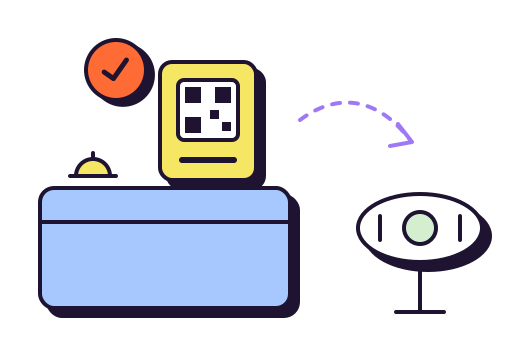
Building the relationship in person
An email does not replace a visit. Drop by the front desk outside check-in hours, introduce yourself and leave the kit. Better still, invite the reception team or the B&B owner for lunch: people recommend with conviction what they have tasted.
A few simple habits keep the relationship going:
- tell your partners about closures, new menus and special evenings, a week or two ahead;
- look after their guests: people who arrive saying “the hotel sent us” should feel expected;
- return the favour: when a guest asks you where to stay or what to visit, mention your partners.
What about commission?
Some partners ask for a fee per guest sent, others do not. There is no standard: it is a negotiation between you. A few pointers to keep things calm:
- favour reciprocity where you can: a welcome drink for referred guests, a meal for the front desk team, recommendations going the other way;
- if you pay a commission, put it in writing, with the amount and how guests are counted, and ask your partner for an invoice; your accountant will tell you how to record it;
- never quietly add it to the referred guest’s bill: they would pay more than the next table, and they would find out eventually.
A booking that comes through your own link costs you nothing extra. To see how that differs from platforms that take a cut per cover, read our article on commission-free online booking.
Measuring what each partner brings
Without numbers, you cannot tell whether a partnership is worth the free drinks. Two simple methods:
- ask the guest, when they book or when they arrive: “How did you hear about us?”, and write the answer in the booking note;
- count by season: how many covers came from the hotel, the B&B, the tourist office?
Tourists are not a marginal clientele. In France, according to INSEE, the national statistics office, non-resident guests accounted for 30.4% of nights spent in collective tourist accommodation in the fourth quarter of 2024. Those guests, more than most, ask their hotel for advice. To take their bookings without speaking their language, see our article on international guests.
In gonnabook.it, the “Direct link” on the Online booking settings page copies in one tap so you can send it to a partner, and the set-up assistant prints an A4 poster with a QR code to stand on a front desk.
Frequently asked questions about partnerships
How do I propose a partnership to a hotel?
Visit the front desk outside check-in hours, introduce yourself and leave a simple kit: a booking link, a poster with a QR code, your current menu and your exact opening hours. Then invite the reception team for lunch, because people recommend a restaurant more readily once they have eaten there. Keep the hotel informed about closures and new menus.
Should I pay a hotel commission for sending guests?
It is not required: it is an agreement between the two of you. Many partnerships run on reciprocity, with recommendations in both directions or a small gesture for referred guests. If you do pay a commission, put it in writing with the amount and the way guests are counted, ask for an invoice and check with your accountant how to record it.
How do I get listed by the tourist office?
Contact the tourist office for your town or area directly. In France the tourism code makes it responsible for welcoming and informing visitors and promoting local tourism, but each office sets its own listing rules: some list restaurants for free, others require a membership. Prepare a short description, photos, your opening hours and your booking link.
Sources
- Légifrance, Code du tourisme, article L133-3 (in French), the missions of the tourist office, current version, accessed 18 November 2026.
- INSEE, Au quatrième trimestre 2024, la fréquentation des hébergements collectifs touristiques augmente de 3,2 % sur un an (in French), Informations rapides, 20 February 2025, accessed 18 November 2026.